How to Follow Up After Sending a Quote (Without Being Annoying)
A quote that goes quiet usually isn't a no. Here's the follow-up timing, wording, and cadence that wins the job back — and how to stop doing it by hand.

TL;DR
A quote that goes silent is almost never a hard "no" — it's a "not right now," a "still comparing," or a "sorry, buried it in my inbox." The money is in the follow-up, and most businesses simply don't do it (or do it once, awkwardly, and give up). Follow up 2–3 days after sending, keep it helpful rather than needy, nudge 3–4 times over two weeks, and — because you will forget on a busy week — make the reminders automatic. Do that and you'll win jobs you're currently writing off as lost.
Why quotes go quiet (it's usually not a no)
Here's the reframe that changes everything: silence is not rejection. When you send a quote and hear nothing back, the most likely reasons are boring and fixable:
- They got busy and genuinely forgot. Welcome to being a human with an inbox.
- They're comparing you against one or two others and haven't decided.
- They're waiting on someone else — a partner, a landlord, budget sign-off.
- Your quote slid down the inbox under 40 other emails by Tuesday.
Notice what's not on that list very often: "your price was outrageous and I hate you." People will happily ghost a quote they were 80% sold on, simply because nobody nudged them over the line. Research on sales follow-up consistently shows that speed and persistence — not lower prices — are what separate the businesses that win the job from the ones that wonder what happened.
The follow-up timeline that actually works
You don't need a 12-step "sequence." You need a simple, humane rhythm that covers the two failure modes: following up too soon (pushy) and too late (gone). This is the cadence that wins the most jobs without wearing out your welcome:
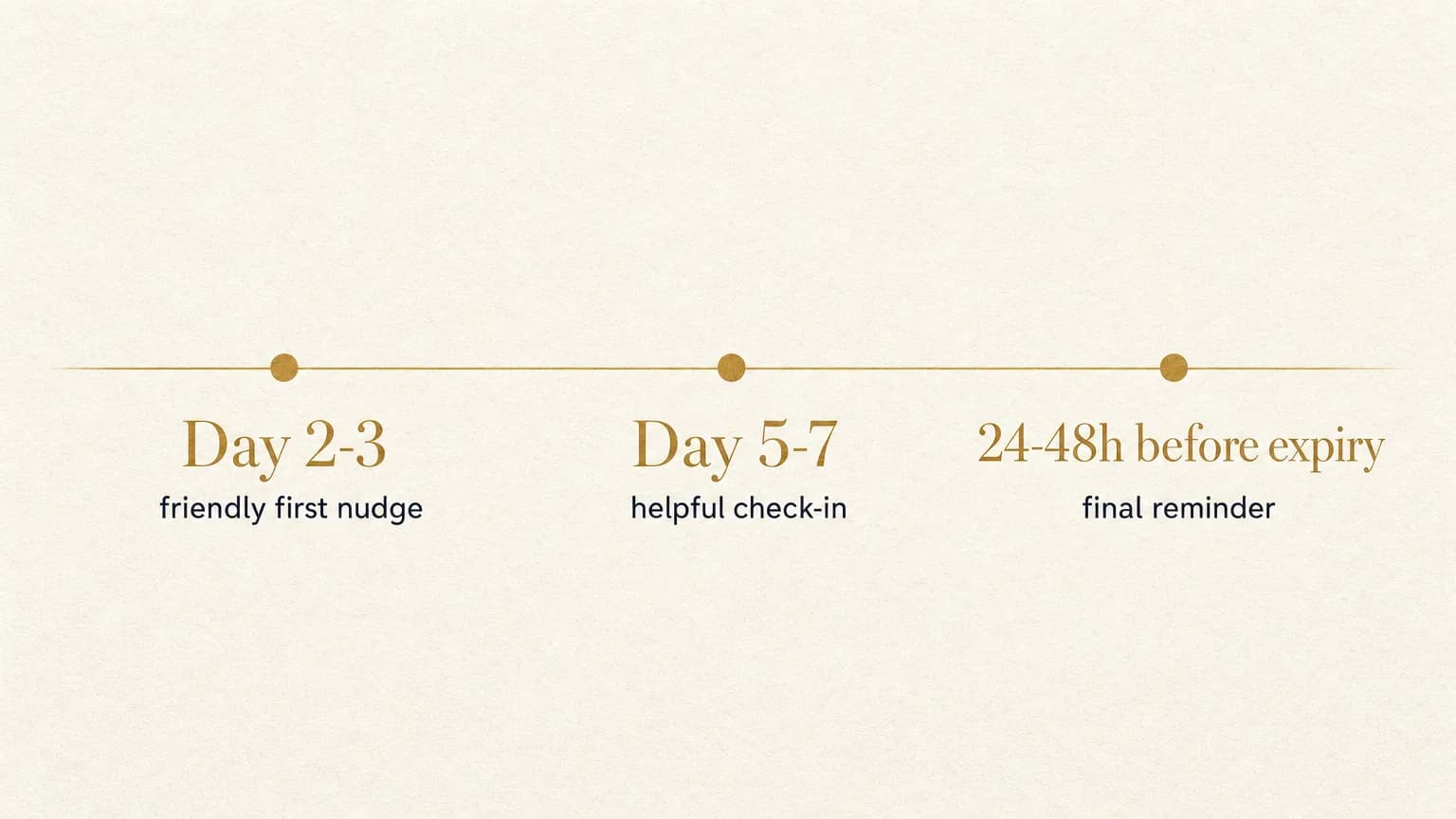
- Day 2–3 — the friendly nudge. Short, warm, zero pressure. "Just making sure this landed and seeing if any questions came up."
- Day 5–7 — the helpful check-in. Add something useful: clarify the scope, offer a quick call, or flag availability ("I've got a slot the week of the 14th if that helps").
- 24–48 hours before it expires — the final call. A gentle deadline is a gift. It gives a busy person a reason to actually decide.
If it's still quiet after that, stop the weekly chasing. Move them to a long-term list and check in once a month or so. Persistent ≠ pest.
What to actually say (three short templates)
The golden rule: lead with help, not "have you decided?" Keep it to a few short lines someone can read on their phone between jobs. Nick these and make them sound like you.
1. The day-2 nudge
Hi [name] — just checking the quote for [the job] reached you okay. Happy to walk through anything or tweak the scope if that's useful. No rush at all.
2. The day-6 check-in
Hi [name] — following up on your [job] quote. If it helps, I could pop round [day] to answer questions, or I've got availability the week of [date]. Let me know what suits.
3. The pre-expiry final call
Hi [name] — the quote for [the job] holds until [date], so wanted to give you a heads-up before then. Still keen to help if the timing works — just say the word.
Three emails. Notice none of them say "have you made a decision yet," which is the follow-up equivalent of staring at someone while they eat.
How many follow-ups is too many?
Most sales that happen at all happen after several touches — yet most people send one follow-up, or none, and quietly conclude that "leads don't convert." Both extremes lose jobs:
- One and done: you're leaving money on the table for the price of two more two-line emails.
- A follow-up every day: now you're the business owner equivalent of a clingy ex. Back off.
Three to four thoughtful touches over about two weeks is the sweet spot for service work. The trick isn't volume — it's spacing and tone.
The real reason follow-ups don't happen
Here's the uncomfortable truth. You already know all of the above. The problem isn't knowledge — it's that following up religiously, on time, for every single quote, while also doing the actual work, is genuinely hard. The quote you sent last Tuesday needed a nudge today, but today you were on a job, then answering the calls you didn't miss, then having something resembling dinner.
So the follow-up doesn't happen. Not because you don't care — because you're one person and the day ran out. This is the same pattern behind most lost revenue in small businesses: it's a follow-up problem, not a lead problem. The leads are already there. They're just quietly going cold.
Make it automatic (so it never slips)
The fix isn't "try harder to remember." It's to take the timing and consistency off your plate and keep the humanity on it. A simple follow-up system:
- Fires the day-2, day-6, and pre-expiry nudges automatically, in your voice, from the moment a quote goes out.
- Stops the moment the customer replies — so nobody gets a "just checking in" email ten minutes after they said yes.
- Hands the real conversations back to you, where you're actually useful.
That's exactly what Axivon's lead capture and follow-up does: every enquiry and quote gets chased on time, every time, without you setting a single reminder. And if the reason quotes go quiet in your business is that enquiries never reach you in the first place, an AI voice agent catches the call and the follow-up together.
The bottom line
A quiet quote is an unfinished conversation, not a lost one. Follow up quickly, keep it helpful, nudge three or four times over a fortnight, and — because busy weeks will always win against your best intentions — make the reminders run themselves. The jobs you thought you'd lost are mostly just waiting for a polite second email.
Want your quotes chased automatically, in your voice, so none ever slip? See how it works or get in touch.
Frequently asked questions
Axivon
Stop losing leads to missed calls and slow follow-up.
Axivon builds AI voice agents, lead capture, and follow-up automation that work while you don't. See what it would look like for your business.